
If you live with a cat, you know privacy is just a dream. You close the bathroom door, and suddenly, tiny paws appear under it, followed by dramatic meows that sound like heartbreak. You try to shut your bedroom door, and boom, there’s instant scratching, yowling, or guilt-tripping stares. You just want five minutes of peace, but your cat acts like you’ve locked them out of paradise.
Here’s the thing: when you wonder why cats hate closed doors, it’s not bad behavior. It’s a mix of instinct, emotion, and simple cat logic. Let’s take a closer look at what’s really going on in your cat’s mind.
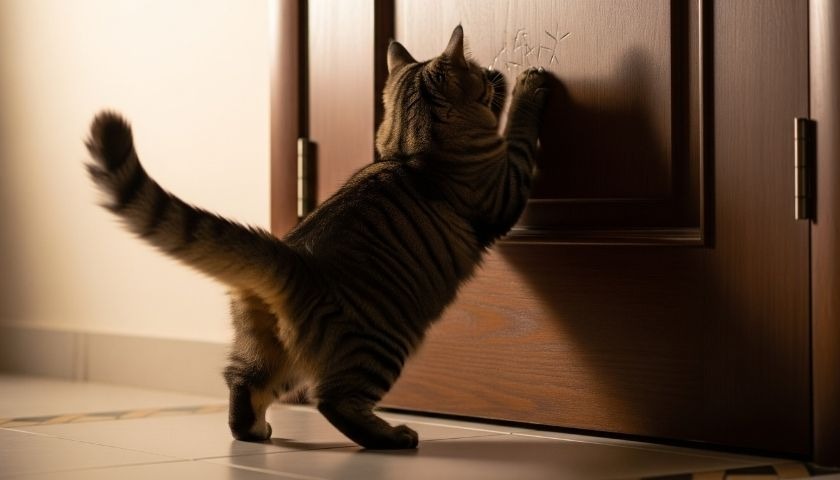
For you, a door is simply something that gives you privacy. To your cat, a door is a big, confusing barrier that suddenly blocks part of their space.
Cats like to be in control. They want to know what is happening in every part of their home. When you shut a door, you block their view and limit the places they can go. This cuts off information about what’s going on around them, which makes them feel tense and on edge.
When that door closes, their brain reacts as if something might be wrong. It activates survival instincts that compel them to explore, protest, or attempt to reopen the door.
Here is what is happening in their brains:
Your home is more than a house for your cat. It is their territory.
In the wild, cats survive by knowing every part of their space. They learn where to escape and where predators might hide.
Because a closed door blocks part of their territory, it creates a “dead zone” that they cannot watch. Not knowing what is behind that door makes them feel unsafe.
Have you noticed your cat walking the same route around the house every day? That’s their patrol. They rub their cheeks on furniture to leave their scent and ensure everything is as they left it.
When a door is closed, it’s like a roadblock on their usual route. It throws off their routine and keeps them from refreshing those scent marks.
People often say cats are just curious, but it goes deeper than that. It’s about control. An open door lets them keep an eye on everything. They may not want to enter the room, but they want to know they can.
When you close the door, you take away that choice. Losing that sense of control is what stresses them out.
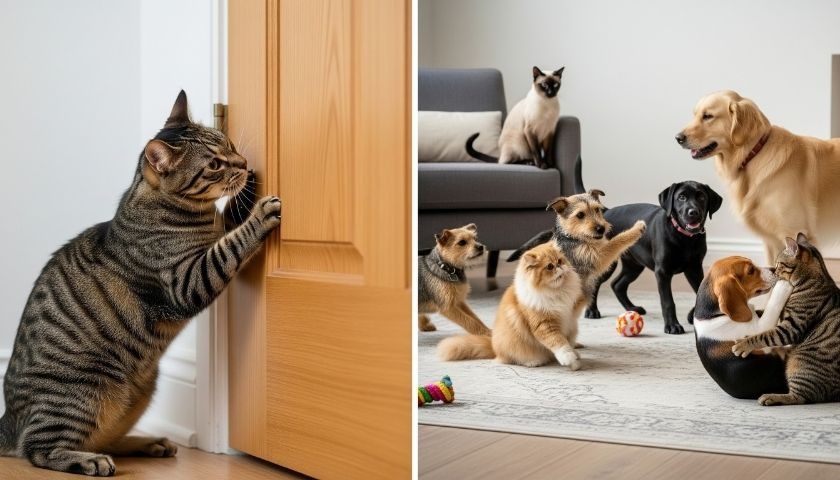
We often joke that cats are loners who barely tolerate us, but that’s not true. Cats are social animals, even if they act differently from dogs.
In the wild, they form colonies. At home, you are their colony leader. When you close them out, it can feel to them like being rejected by the group.
Your cat sees a shut door as a social barrier for these reasons:
They don’t always want attention, but they do want access. You are part of their colony, so if you’re behind a door, something feels wrong. This is a big reason why cats do not like closed doors, even if they weren’t cuddling with you five minutes ago.
From your cat’s perspective, you might be:
If they can’t see you, their mind jumps to the worst‑case scenario. That’s one big reason cats hate it when doors are closed.
Cats relax when they know where you are. To them, being in the same room means a calm cat, and a closed door means uncertainty.
They don’t need constant attention from you. They mainly need to know you are nearby.
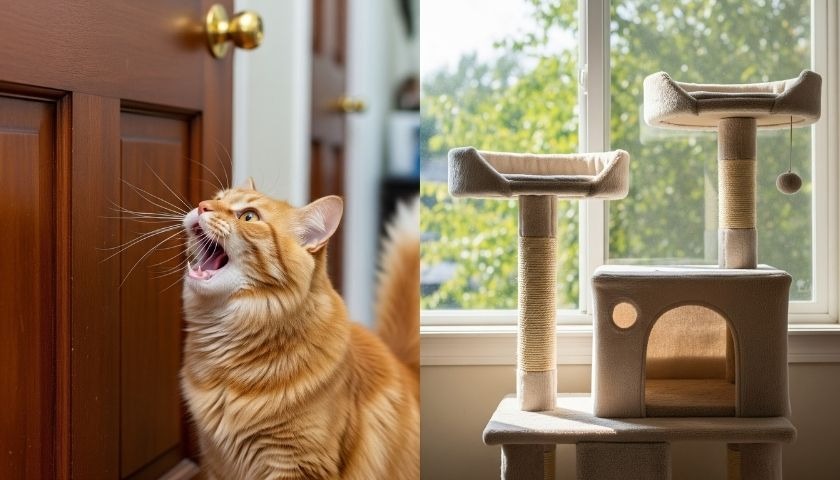
Sometimes, your cat’s reaction to a locked door is not about emotion but about how they sense the world. Cats depend a lot on their senses to figure out what’s going on around them. A closed door blocks smells, sounds, and air movement. Because cats rely on these senses, it limits their information and makes them feel less in control.
Consider these practical issues causing the frustration:
Cats use their sense of smell to figure out what’s going on around them. When a door closes, it traps smells on the other side. Your cat can’t “read” the room or smell where you are. Losing that scent information is confusing and unsettling for them.
Perhaps that closed door is blocking their bowl, their favorite nap spot, or a sunny window perch. From your cat’s point of view, you’ve suddenly put a “Do Not Enter” sign on one of their favorite places.
Cats have excellent hearing, but a closed door muffles sounds. This can make them anxious because muffled noise can signal danger. It can also simply mean they can’t hear you clearly.
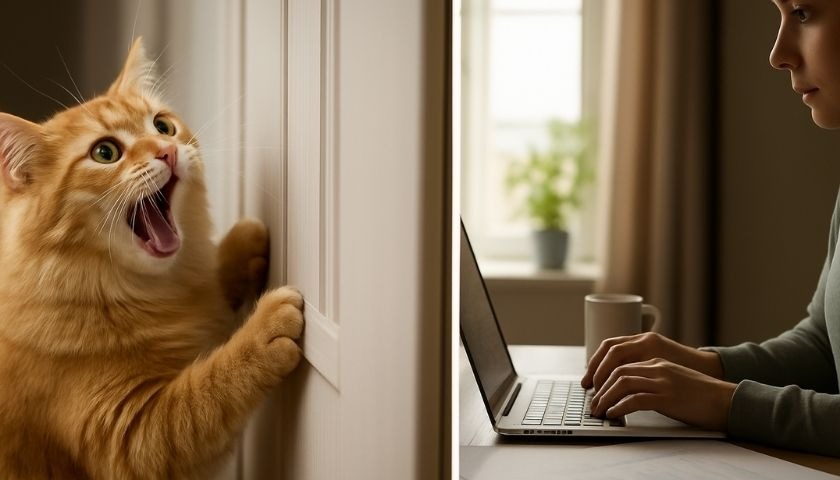
You might wonder if this is normal behavior or a sign that your cat is stressed. There’s a thin line between a pushy cat and an anxious one. For some cats, a closed door can trigger real separation anxiety. This is especially common in “Velcro cats” and in breeds that tend to form strong bonds, like Siamese or Burmese cats.
Here is how anxiety plays a role:
If your cat just sits by the door and waits, that’s usually simple curiosity. But if they pant, drool, slam their body against the door, or yowl nonstop, that’s a sign of real distress.
Why does my cat hate closed doors so much that they seem to panic? A big part of it is fear of being left behind. Cats don’t understand object permanence the way humans do. In their mind, if they can’t see you, you might be gone for good.
Cats are both predators and prey, so they feel vulnerable when they poop, sleep, or eat. During those moments, they look to you for protection.
If you shut yourself in the bathroom, your cat may feel you’ve left them unprotected in the house. Or they may feel they need to guard you instead. They think you’re stuck in a small room with running water, which looks dangerous and needs to be rescued.
It might feel annoying, but your cat’s hatred of closed doors is actually a compliment. It means they like you and want to be near you. If they didn’t care where you were, they wouldn’t care about the door. How strongly they react often shows how strongly they are attached to you.
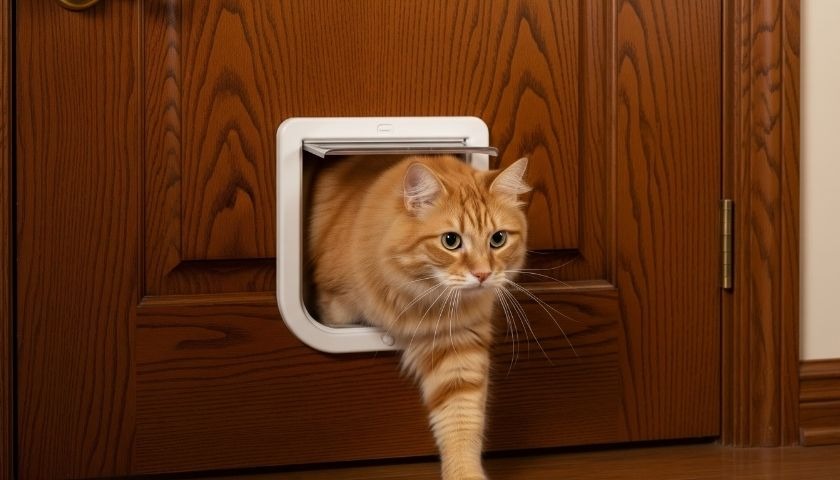
You now understand why cats hate closed doors, but you still need bathroom privacy. You don’t have to remove every door. Instead, you can manage this behavior with a few simple changes to your home and routine. The goal is to make a closed door feel normal, not like a big deal.
Try these strategies to reclaim your privacy:
Start small. Close the door for just a few seconds, then reward your cat when they stay calm. Slowly increase the time the door is closed. With consistent positive reinforcement, your cat can learn that a closed door is not something to worry about.
A few small changes can make life calmer for both you and your cat:
A bored cat often focuses on closed doors. Give them more to do instead. Cat trees, window perches, and scratching posts can help them use up that extra “patrol” energy.
So, why do cats hate closed doors? There are many reasons for this. Closed doors break up their territory, block important scents and sounds, take away their sense of control, and separate them from you. It’s not about spite or bad behavior. It’s driven by instinct and their attachment to you.
The goal isn’t to fight your cat’s behavior but to find a middle ground. To do this, leave the door slightly open when possible. When you can’t leave the door open, set up a comfortable spot nearby. Lastly, look for solutions that respect both your cat’s instincts and your need for space.
Want peace at home? Browse cat-friendly door accessories, anxiety-relief toys, and enrichment gear designed for cats who just really, really need to know what’s happening on the other side of the door.
Your doors will survive. Your cat will chill out. And you might, at long last, get to pee in peace.